Rapid Fusion and LEAM have announced Prometheus, a robotic cell designed to produce large-format parts and tooling in PEEK and PEI for aerospace, maritime and oil and gas manufacturers. Unveiled at Formnext, the system incorporates LEAM’s layer adhesion technology into a Rapid Fusion cell. The partners designed a new extruder to hold a heated adhesion nozzle, with sensors monitoring temperature as material is deposited. The nozzle heats the…
The University of Malta is examining how to certify the privacy of quantum random-number generators used in online gaming through its GRYFFIN-Q research project. The project aims to increase the amount of private randomness that can be certified from a finite number of uses of a device. Its researchers plan to develop tighter security bounds that account for statistical fluctuations when the number of measurements is limited. Quantum…
The US Food and Drug Administration declined to approve Summit Therapeutics’ ivonescimab for patients with EGFR-mutated non-small cell lung cancer, citing concerns about the Phase 3 HARMONi trial’s survival results, safety and relevance to US patients. Summit announced the decision on 15 November 2026. The FDA’s letter, published two days later, explained why the agency did not consider the trial’s progression-free survival result sufficient to…
The European Quantum Industry Consortium (QuIC) has welcomed the European Commission’s proposed European Quantum Act and plans to press lawmakers for public procurement commitments of €7.7 billion to €12.3 billion over five years. The industry group also wants a dedicated quantum allocation in the proposed Sovereign Tech Equity Fund, with access for scale-ups as well as start-ups. QuIC says it will gather views from its more than 240 member…
Eclypsium’s November InfraTrust Pulse report found that AI-assisted vulnerability disclosures can increase the volume of security advisories without speeding up the arrival of fixes for affected infrastructure products. The report tracked 373 advisories from 23 infrastructure vendors over 36 days, covering 3,880 distinct vulnerability identifiers. More than half of the advisories appeared on a single day. The data covered network equipment…
The Devcon team announced that Devcon 6 would take place in Bogotá, Colombia, in 2021, at the Agora Bogotá Convention Center. The Ethereum Foundation blog post, published on 28 May 2020, did not give a firm event date. The team said its selection followed a search that began before Devcon 5 and assessed options in more than 10 cities. It described strong community demand for a South American event and said Bogotá offered a venue capable of…
France’s Senate has rejected amendments that would have required taxpayers to declare self-custodied crypto holdings worth more than €100,000 ($110,000), according to the official record of Tuesday’s debate on the 2027 budget. Two amendments proposed the disclosure requirement: one from the Communist-led CRCE-K group and another from a group of senators led by Anne-Sophie Romagny. Both were voted down after the government and the Senate’s…
Robotics startup Lute has raised a combined $20 million across pre-seed and seed funding, with the new seed round co-led by OTB Ventures and FORWARD.one. The company plans to use the capital to collect more tactile data, improve its models and support customer deployments. Seedcamp, Credo Ventures, Naval Ravikant, Inovo VC, ff Venture Capital and Borusan Ventures also took part, OTB Ventures said on 25 November 2026. Lute is developing…
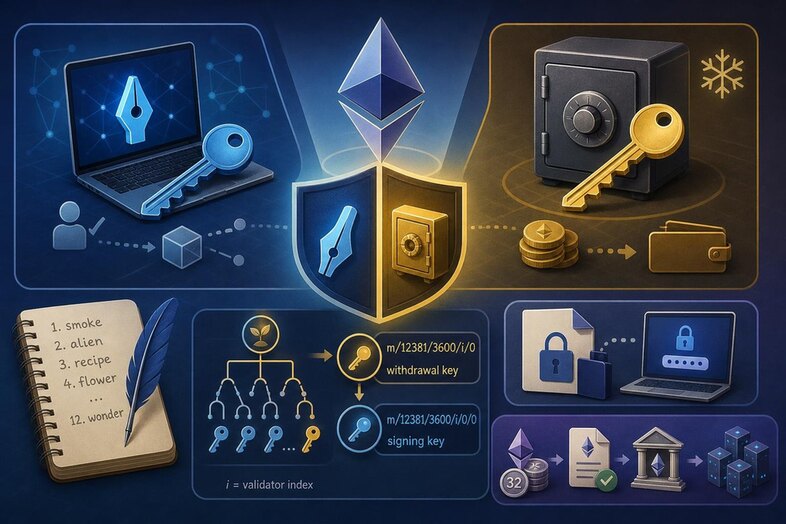
The Ethereum Foundation outlined how eth2 validators would manage signing and withdrawal keys in a post published by Carl Beekhuizen on 21 May 2020. The design assigns validators two key types, with different roles and storage requirements. In a proof-of-stake system, validators use signatures to identify their actions. Signed messages can help establish whether a validator followed the rules or acted against consensus. In eth2, the validator’s…
The Ethereum Foundation has doubled its protocol security team and made cryptography its top priority, according to a Decrypt newsletter report that cites protocol lead Kev Wedderburn. The shift reflects concern that artificial intelligence could expose weaknesses in the cryptographic methods used by major blockchain networks. Wedderburn wrote this week that AI had emerged as a more urgent risk than quantum computing. The distinction is about…