
Rapid Fusion and LEAM develop heated-nozzle cell for large-scale PEEK and PEI printing
 Rendy
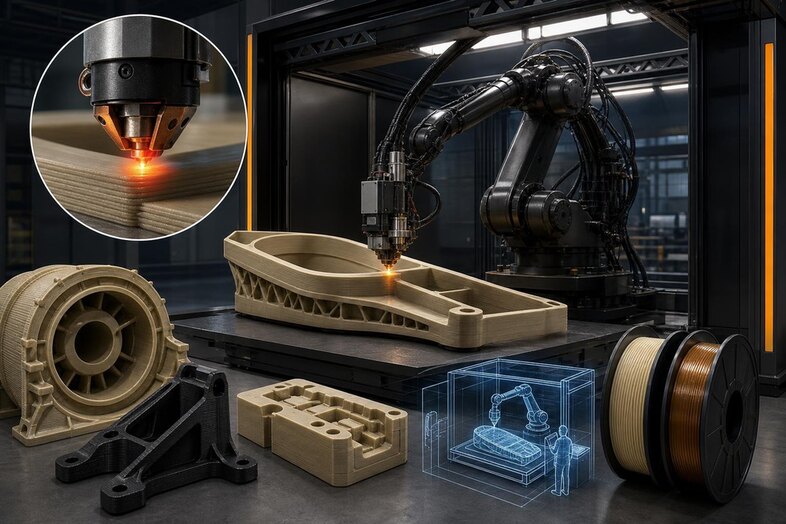
Rapid Fusion and LEAM have announced Prometheus, a robotic cell designed to produce large-format parts and tooling in PEEK and PEI for aerospace, maritime and oil and gas manufacturers.
Unveiled at Formnext, the system incorporates LEAM’s layer adhesion technology into a Rapid Fusion cell. The partners designed a new extruder to hold a heated adhesion nozzle, with sensors monitoring temperature as material is deposited. The nozzle heats the interface between each fresh layer and the material beneath it, aiming to improve the bond between layers.
Heating the interface during printing
Rapid Fusion and LEAM say the temperature-sensing process adjusts the heat during a print. They have not provided numerical performance results or quantified improvements in accuracy, strength or printing speed. The companies say the design directs more power into the build space and could allow users to print thinner-walled parts with less material.
Prometheus is also intended to let users pause a print to add inserts or change the process. The companies describe this as flexibility beyond that of standard cells, although the announcement does not detail which inserts or process adjustments are supported.
The system’s target polymers are polyether ether ketone (PEEK) and polyetherimide (PEI), materials the partners identify as difficult to process in large-format additive manufacturing. LEAM says both are already certified across key industrial applications. That could let customers use established materials without taking on the cost of certifying new ones, though the announcement does not specify the certifications or applications covered.
Designed for structural parts and tooling
Rapid Fusion Managing Director Jake Hand said the cell would enable large-format printing with PEEK and PEI. LEAM CEO and co-founder Dr Patrick Consul said the intended work includes structural parts and tooling, and argued that lower material use could benefit the environment. The companies have not published material-consumption figures to quantify that potential reduction.
Rapid Fusion and LEAM developed the nozzle, sensors and other proprietary components together, focusing on integration, ease of use and performance. The collaboration builds on earlier work: Rapid Fusion’s previous robotic cells combined additive and subtractive machining, and the companies had retrofitted LEAM’s adhesion system onto those cells before designing Prometheus jointly.
LEAM has also demonstrated heating technology with another large-format additive manufacturing company, CEAD Group. At Formnext 2024, the partners presented a light-based welding system with real-time temperature monitoring. Prometheus uses a heated nozzle instead, but both approaches pair heat with temperature control to process challenging materials.
First deliveries planned for next year
Rapid Fusion says customers have signed up for the first Prometheus deliveries, and the company plans to release the cell early next year. It expects the system to generate more than £2 million in combined revenue over the following two years. That figure is a company forecast, not reported sales.
The announcement gives no price or detailed delivery schedule. For prospective users, the confirmed plan is a release early next year, with the first deliveries already attracting customer sign-ups, according to Rapid Fusion.