
IndiaAI Mission Presents Chariot-1 Foundation Models for English and 10 Indian Languages
 Rendy

IndiaAI Mission announced on 25 November that Ministry of Electronics and IT Secretary S. Krishnan had inaugurated Chariot Artificial Intelligence’s Chariot-1 foundation models, developed in India from scratch for English and 10 Indian languages. The presentation took place at Chariot One, a launch and research showcase at Bharat Mandapam in New Delhi.
Chariot is one of the first four teams selected by the mission to build sovereign foundation models. IndiaAI described three design choices intended to reduce the costs of representing Indian-language text and training models at different scales.
Language representation and training
Chariot-1 uses IndicShift, a shared alphabet for Indian scripts that IndiaAI says uses 2.5 times fewer tokens on Indian text. Tokenisation breaks text into units that a model processes; reducing the number of tokens needed to represent text can make that processing more efficient.
The team’s Nested Training method produces three model sizes in a single training run. IndiaAI reports that it makes training 62% faster. A separate approach, Mixture of Vocabularies, is reported to deliver 38% faster training. The source does not specify the comparison baselines or provide further testing conditions for those figures.
These techniques address different parts of model development: IndicShift changes how Indian-language text is represented, while the two training approaches target the work involved in producing models. The announcement does not provide model parameter counts or a public availability date for the foundation models.
Speech models and reported results
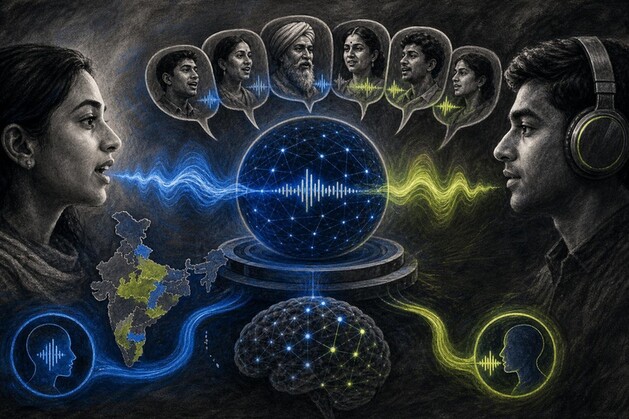
Chariot has already described task-specific speech systems built on a shared Chariot-1 foundation. Its 12 November release of Chariot-1-TTS-Multilingual supports speech generation in 11 Indic languages and English, with more than 50 voices. The company says it can mix languages within a sentence and clone a voice from a few seconds of reference audio. It also handles prices, dates, abbreviations and symbols in context.
In an evaluation published by Chariot on 11 November, the model recorded a 7.60% Hindi character error rate, 93.78% English verbalisation accuracy on its English suite and a 4.901 NISQA score, an automated estimate of audio quality. Chariot said it ranked first among the configurations compared on these measures.
An earlier release, Chariot-1-ASR Realtime, dated 22 October, provides streaming speech recognition for 10 Indian languages and Indian English. Chariot reported the lowest word error rate in each language against every streaming API and batch model it tested. It also said the system’s average across the 10 languages had 26% fewer errors than Google Gemini 3.5 Transcribe’s batch API. The company describes ASR as a task adaptation of its speech-reasoning backbone, rather than a standalone model built exclusively for recognition.
From speech tasks to a broader system
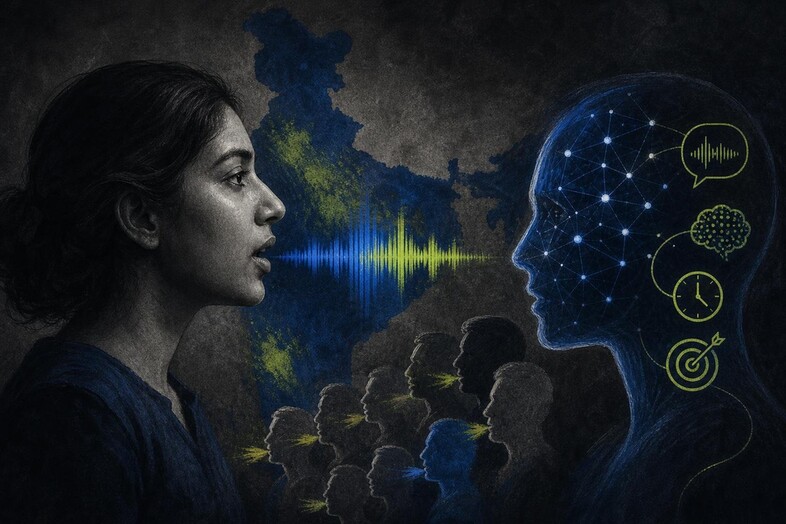
Chariot, headquartered in Delhi and led by co-founders Parth Sarthi and Suvrat Bhooshan, says its roadmap is to develop a speech-native model that reasons across meaning, delivery, timing and action. The company’s current public examples are speech generation and recognition, which developers can access through its platform and API. The broader reasoning system remains part of its stated roadmap.