
QKD Could Add Protection to Selected Critical Links, but Its Guarantees Depend on Deployment
 Rendy
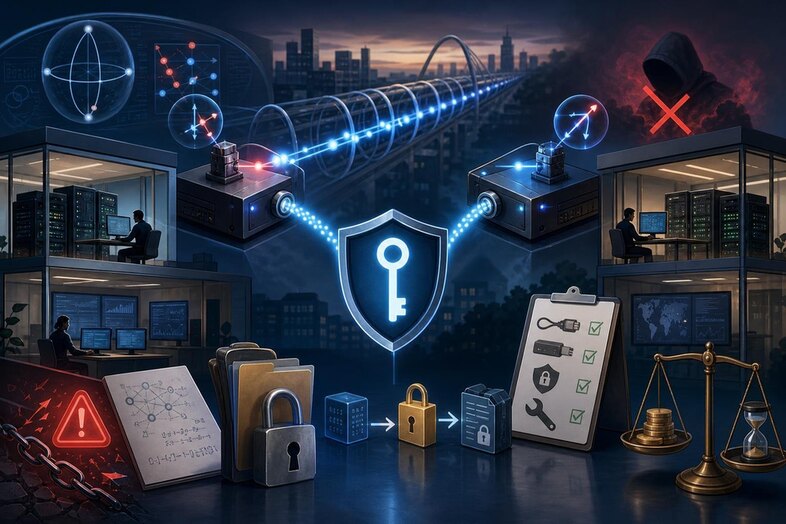
Ofir Joseph, Irit Hadar and Miriam Shtilman argue that quantum key distribution (QKD) could provide an extra layer of protection on selected critical connections, alongside post-quantum cryptography (PQC). Their case follows reports of AI-assisted cryptographic research, but the authors stress that none of the cited results demonstrates a practical break of deployed RSA-2048.
The guest article distinguishes research that improves or explores attacks from evidence that commonly used encryption has been broken. It also frames QKD as a way to help two sites establish a shared secret key, not as a replacement for the encryption used to protect data.
What the reported attacks show
Google DeepMind’s November working papers describe two lines of RSA research. One repeated a computation used in attacks on RSA-1024 signatures more efficiently, following billions of advance calls to a signing interface that accepted chosen numerical inputs. The work did not recover the private key. The other paper proposed theoretical savings from shared work when attacking multiple RSA keys of the same size; the approach has not been implemented.
The authors also refer to studies using AI to analyse simplified encryption methods or exploit information leaked by particular devices. They say these findings do not demonstrate a mathematical break of standardised PQC algorithms.
A separate case concerns HAWK, a proposed digital signature scheme that took part in the US National Institute of Standards and Technology’s additional post-quantum signature process. In July 2026, Anthropic reported that a researcher working with Claude had improved an attack on HAWK. A preprint described key recovery for a small HAWK-256 test instance and lower estimated attack costs for HAWK-512 and HAWK-1024. HAWK’s designers confirmed the attack and withdrew the scheme on 29 July, saying straightforward fixes would make it uncompetitive. HAWK had not become a NIST standard.
These examples matter to QKD because digital signatures help establish who signed data and whether it has changed. QKD exchanges also need participants and messages to be authenticated. If a signature failure enables impersonation during an exchange, it can undermine the QKD process. The authors present HAWK as an example of how security assessments can change, while separating that issue from the case for QKD’s protection of shared keys.
How QKD fits alongside PQC
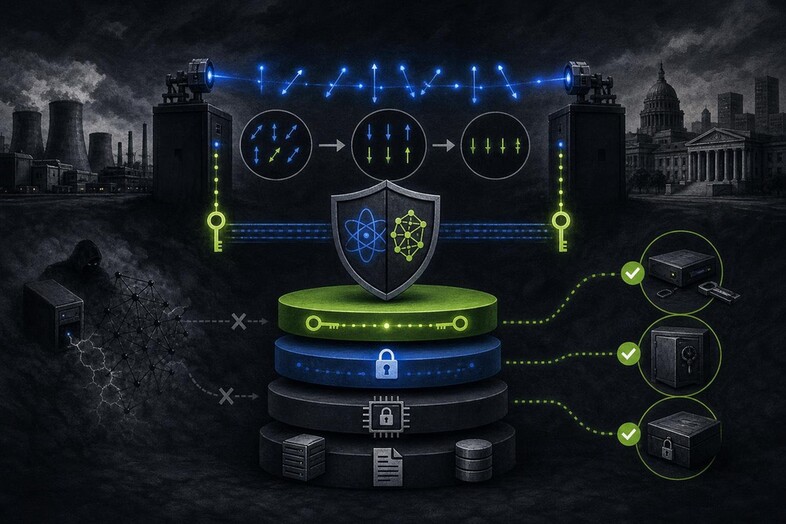
PQC uses mathematical methods selected to resist attacks from quantum computers. The authors describe it as the priority for protecting critical infrastructure. QKD, they argue, may add protection on specific links where information must remain confidential for years.
In QKD, two sites use prepared light signals to establish a shared secret. They compare measurements and process the results into a shorter key, with a calculated limit on how much an eavesdropper could learn. The authors say that limit can be proved without restricting the attacker’s computing power, provided the equipment and exchange meet the assumptions of the proof.
A combined QKD-and-PQC design could protect an agreed encryption key even if the PQC key-exchange method later failed, but only if the design’s security proof covers that failure and QKD’s contribution remains protected. The sites must authenticate messages, confirm that they belong to the current exchange, and safeguard the equipment and keys as they are delivered, stored and used. A secure exchange alone does not protect data if keys are exposed elsewhere or the data encryption itself is compromised.
QKD supplies keys; it does not encrypt the records by itself. If AES protects the information, security still depends on AES and the computers using it. Stored copies also require protection.
Network results and deployment limits
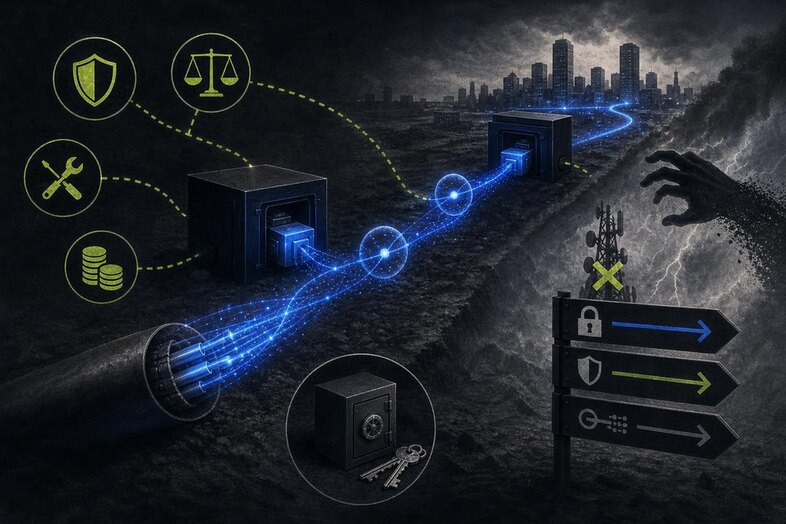
A 2025 field demonstration reported an average secret-key rate of about 110 bits per second over 254 kilometres of a commercial telecom network during a 7.5-hour run. In that particular design, a central measurement station did not need to be trusted with the secret key. Other QKD networks use intermediate stations that do require trust.
The reported rate measures key generation, not data transmission. Usable keys require enough measurements and further processing. Since a short key can protect much larger amounts of data with AES, the authors say modest key rates may still support regular key changes. Each deployment needs evidence on usable-key supply, reliability, maintenance and cost. Some QKD designs can share fibre with ordinary data traffic, so a dedicated fibre is not always required.
Guidance cited in the article also limits the case for adoption. The UK’s National Cyber Security Centre does not support QKD for government or military applications and says it should not count as evidence of data-in-transit security under its Cyber Assessment Framework. The US National Security Agency does not recommend QKD for National Security Systems unless identified limitations are overcome.
The authors also point to a 2025 peer-reviewed analysis that found limited benefits in many documented QKD use cases it examined. Securely stored initial keys, or methods for generating successive keys from a shared secret, may meet some long-term needs without frequent physical delivery. QKD can replenish shared secrets remotely, but other approaches can refresh keys too; the relevant comparison is what each guarantees and requires.
Denial-of-service attacks are another concern. The article says operators should plan for attackers forcing an automatic switch to protection without QKD, and decide how to use protected key reserves, whether sensitive transfers should wait, and whether an authorised fallback to PQC alone is acceptable. The authors’ case is therefore for evaluating QKD on selected links against a specific security proof, equipment assumptions and operational requirements, rather than treating it as a universal solution.