
Ethereum’s EIP-1559 debate brought wallet developers into the fee-market design
 Rendy
Griffin Ichiba Hotchkiss’s June 16, 2020 post on the Ethereum Foundation Blog examined how EIP-1559 and Dan Finlay’s Escalator proposal could change transaction fees, and how wallet developers were shaping the discussion around their effects on users.

Changing the fee mechanism
Ethereum’s then-current system used a first-price auction: users set a gas price, and miners generally prioritised transactions offering higher fees. Hotchkiss described how this could drive costs sharply higher when blocks were nearly full, as users bid against one another for prompt inclusion. Fee-estimation tools in wallets also had to predict what users might need to pay.
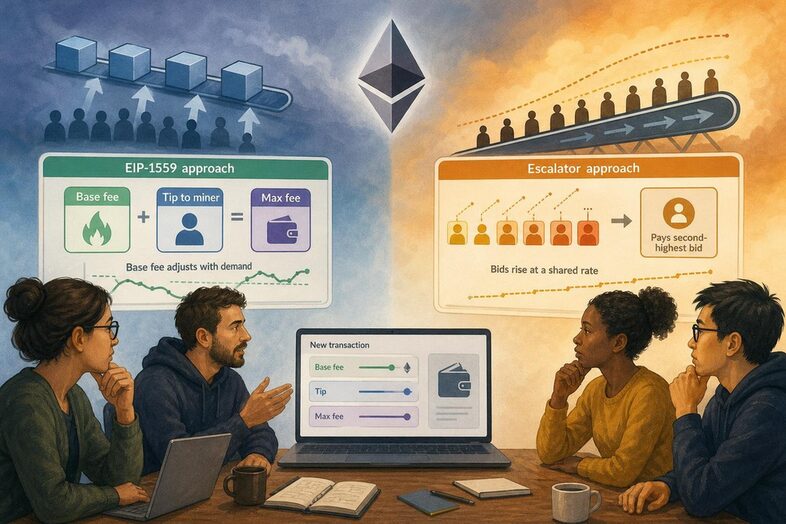
EIP-1559 proposed a different structure. It would set a network base fee that adjusted according to demand, with the mechanism aiming to move block gas usage towards a 10 million gas limit. The base fee would be burned rather than paid to miners. Users would also set a tip for miners and specify the maximum they were willing to pay.
That separates the network-set base fee from the user’s tip. Hotchkiss wrote that the approach was intended to make fees more predictable and reduce the risk of users overpaying because of the existing auction dynamics. The proposal would also require wallet software to adapt to its new transaction-fee parameters.

Escalator offered a comparison
Wallet developers did not reject the goal of improving Ethereum’s fee market, the post said. Their feedback focused on the work required to update software and on what the changes would mean for transaction users. Finlay’s Escalator algorithm offered a concrete alternative for comparing approaches.
Under Escalator, users would submit bids that rise gradually at a shared rate, up to a maximum amount set by the user. The bids would form a queue, and the user would pay the second-highest bid rather than their own maximum. Unlike EIP-1559, Escalator would not alter the mechanism that determines block size.
Hotchkiss presented the proposals as ways to examine fee-market design and user experience, not as an approved network upgrade. The post said the discussion had not reached the point of being ready for the next hard fork. At the time of publication, EIP-1559 and Escalator remained proposals under discussion.